Upon your arrival at Tribhuvan International Airport, a representative from Hidden Path Treks & Expeditions will greet you and transfer you to your hotel in Kathmandu. After check-in, you can rest from your journey or explore the vibrant streets of Thamel, the tourist hub of the city. In the evening, we’ll conduct a short briefing session about the expedition and enjoy a welcome dinner.
Today is reserved for final preparations and necessary permit arrangements. You’ll meet your climbing guide, check your gear, and shop for any last-minute equipment. A guided city tour can also be arranged if you wish to explore UNESCO World Heritage sites such as Swayambhunath (Monkey Temple), Pashupatinath, and Boudhanath.
A scenic mountain flight takes you to Lukla, the gateway to the Khumbu region. After meeting the rest of the trekking team and porters, we begin our trek through forested trails and small Sherpa settlements, descending and then ascending gently to reach Paiya (Chutok), a peaceful village nestled in the hillside.
We begin our day by crossing a narrow bridge and ascending through dense forests. The trail offers breathtaking views of the surrounding hills and valleys. Passing several ridges and terraced farmland, we arrive in the village of Panggom, home to the ethnic Rai and Sherpa communities.
Today’s trail winds through rhododendron and bamboo forests, offering opportunities to spot wildlife like red pandas and Himalayan monals. After crossing the Panggom La pass, we descend to the Ningsow Valley. The serene village of Ningsow provides a tranquil overnight stay surrounded by pristine wilderness.
A longer trek today leads us through Makalu Barun National Park. The trail includes both ascents and descents through thick forests, narrow ridges, and steep hillsides. We eventually join the main trail of the Mera Peak route at Chhatra Khola, a key junction for climbers.
Continuing northward, we walk alongside the Majang Khola before merging with the Hinku Khola. The trail gradually ascends as we enter a region of alpine forests filled with pine and moss. We reach the riverside settlement of Kothe by afternoon, where we rest and acclimatize.
Today’s shorter trek allows time for acclimatization. We hike along the west bank of the Hinku Khola, with impressive views of Mera Peak starting to appear. Passing through dense forest and yak pastures, we arrive in Thaknak, a small grazing settlement with a backdrop of glacial moraines.
A gradual ascent through lateral moraines and rocky terrain takes us to Khare, our base before climbing Mera Peak. Along the way, we enjoy striking views of Kusum Kanguru and the north face of Mera. Upon arrival, we settle in for rest and altitude acclimatization.
A full day is dedicated to acclimatization and basic mountaineering training. Our climbing guides will teach you rope techniques, ice axe usage, and crampon walking on snow. This hands-on session boosts your confidence for the summit climb and ensures safety at higher altitudes.
Today we climb to Mera High Camp, navigating a steep trail over Mera La Pass. The path becomes icy and exposed, requiring caution and the use of mountaineering gear. High Camp, set on a rocky outcrop, offers stunning sunset views over Everest, Lhotse, Makalu, and other peaks.
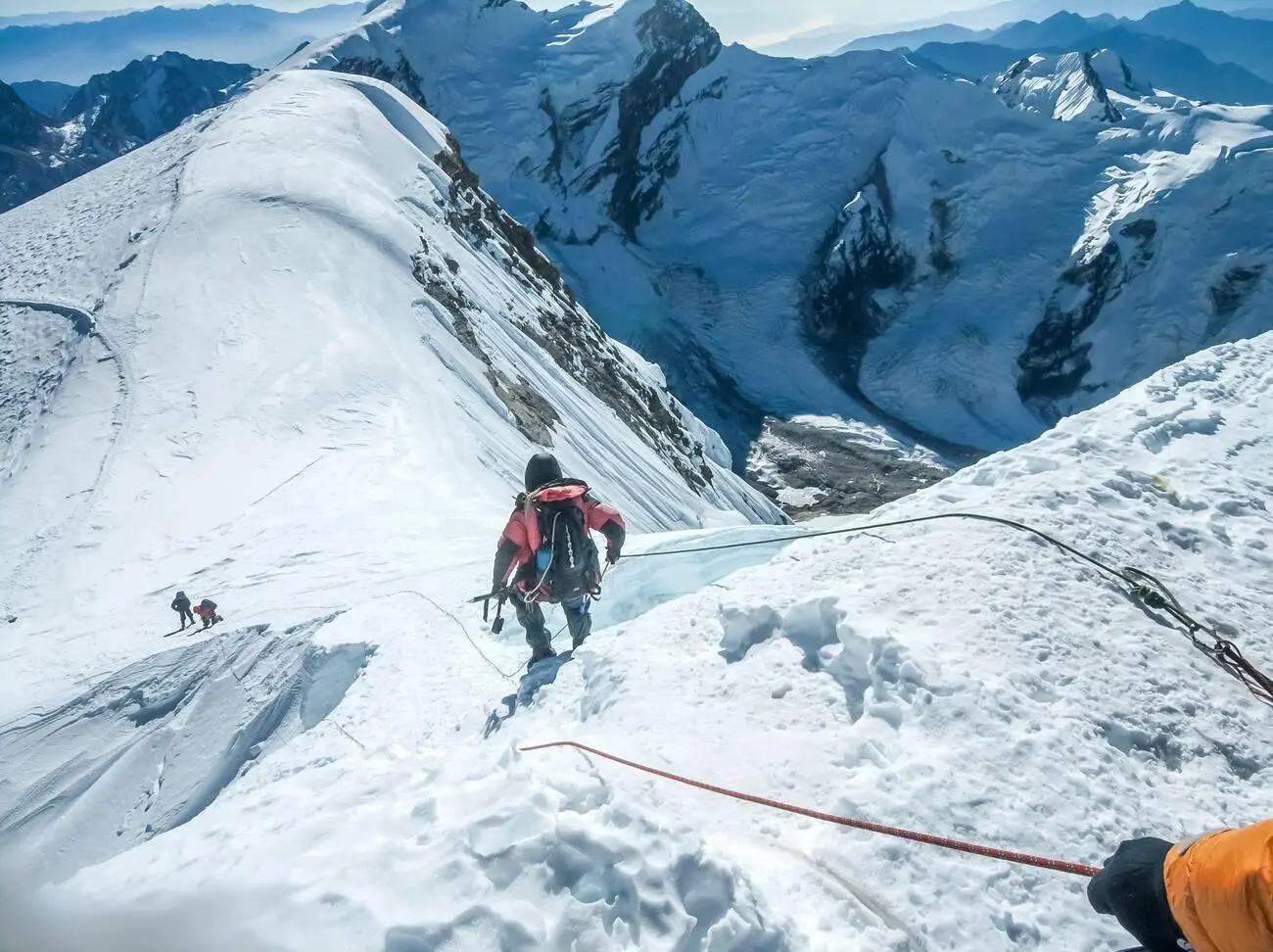
We begin the summit push around 2 AM, climbing gradually over snow slopes. The final stretch to the summit may require fixed ropes depending on conditions. Reaching the top of Mera Peak, the highest trekking peak in Nepal, rewards us with unparalleled views of five 8,000-meter giants. After celebrating briefly, we descend carefully back to Khare for a well-earned rest.
This buffer day allows flexibility in case of bad weather or other delays. If unused, it can be spent relaxing in Khare or descending to a lower altitude for added comfort.
We retrace our steps through Thaknak and down to Kothe. The descent feels easier on the lungs, and we take time to enjoy the natural beauty that may have been overlooked during the ascent. Tonight, we celebrate our successful climb with the team.
Today’s trail ascends again through lush forests and ridges with beautiful mountain views. After a steady climb, we reach Thuli Kharka, a scenic pastureland often used by yak herders. The area is peaceful and ideal for our final night in the wilderness.
A challenging yet rewarding day as we cross the Zatrwa La Pass, which provides a final panoramic view of the Himalayas. The steep descent leads us back to Lukla, where we celebrate the end of our expedition with the crew before flying out the next day.
An early morning flight returns us to Kathmandu. After check-in at the hotel, the rest of the day is free for sightseeing, shopping, or simply relaxing. A farewell dinner is arranged by Hidden Path Treks & Expeditions to commemorate your achievement.
Our team will transfer you to the airport for your departure flight. As you head home, you take with you unforgettable memories, newfound strength, and stories of summiting one of Nepal’s most iconic trekking peaks.
Mera Peak (6,476 meters / 21,247 feet) is the highest trekking peak in Nepal and a perfect introduction to Himalayan mountaineering. Located in the Khumbu region, south of Mount Everest, the climb offers incredible panoramic views of five of the world’s highest mountains—Everest, Lhotse, Makalu, Cho Oyu, and Kangchenjunga. Organized by Hidden Path Treks & Expeditions, the 18-day Mera Peak expedition blends scenic trekking through remote Himalayan valleys with a moderately technical alpine ascent, making it ideal for adventurous trekkers seeking their first high-altitude climbing experience with minimal technical complexity.
Mera Peak is a non-technical trekking peak, but the climb still demands strong physical fitness, endurance, and the ability to adapt to high altitudes. While prior climbing experience is not mandatory, basic mountaineering skills—such as using crampons, ice axe, harness, and ropes—are helpful. Hidden Path Treks & Expeditions provides a pre-climb training session at base camp to teach or refresh these skills. If you are a fit trekker and have done high-altitude trekking (above 4,000 meters), you can absolutely consider Mera Peak with confidence.
The expedition begins with a scenic flight to Lukla, followed by an off-the-beaten-path trek through the beautiful Hinku Valley, passing through Panggom, Ramailo Danda, and Khare, the base camp area. After several days of acclimatization and training, climbers push toward Mera High Camp, and then aim for the summit before returning via the same route. The itinerary includes flexible acclimatization days, buffer for weather delays, and ample time to soak in the remote mountain wilderness. Hidden Path Treks & Expeditions ensures every day is strategically planned for success and safety.
Yes, all required permits are arranged and included in the package by Hidden Path Treks & Expeditions. These include the Mera Peak Climbing Permit, the Makalu Barun National Park Entry Permit, and the Khumbu Pasang Lhamu Rural Municipality Entry Permit. The company handles all logistics, so you can focus on preparing for the adventure.
During the trekking portion of the journey, accommodation is in local teahouses and mountain lodges, which are simple but clean and welcoming. Once above Khare, at high camp and base camp, climbers sleep in tented camps, equipped with sleeping pads and all meals provided by the support crew. Meals on the trek consist of hearty Nepali and international dishes such as dal bhat, soups, rice, pasta, and vegetables, while nutritious high-altitude meals are specially prepared at camp. Hidden Path Treks & Expeditions ensures safe and hygienic meals throughout the trip.
Yes, altitude sickness is a key concern on Mera Peak due to the summit height of nearly 6,500 meters. Hidden Path Treks & Expeditions prioritizes gradual ascent, acclimatization, and client health monitoring. Guides are trained in high-altitude first aid, carry pulse oximeters and emergency medications, and will monitor your condition daily. If needed, emergency descent or helicopter evacuation can be arranged (travel insurance required). The route is designed with sufficient acclimatization days and an optional summit contingency day to increase your chances of a safe and successful climb.
The climbing package includes airport transfers, domestic flights to and from Lukla, all accommodations and meals during the trek and climb, climbing permits, experienced guide and porters, climbing gear rental (optional), camping equipment, and government taxes. Not included are international flights, personal travel insurance, personal climbing gear (boots, jackets, gloves, etc.), tips, alcoholic beverages, Wi-Fi, and hot showers at lodges. Hidden Path Treks & Expeditions provides a transparent breakdown of inclusions and can assist you with gear rental and preparation in Kathmandu.
The best seasons are pre-monsoon (March to May) and post-monsoon (late September to early November). These months offer clear skies, stable weather, and ideal snow conditions for climbing. Winter ascents (December–February) are also possible but require preparation for extreme cold. Monsoon season (June to August) is generally avoided due to heavy rain and flight disruptions.
You’ll need both trekking and mountaineering gear, including insulated boots (B3-rated), crampons, climbing harness, helmet, down jacket, sleeping bag (-20°C or lower), gloves, gaiters, and layered clothing. Hidden Path Treks & Expeditions provides a full gear checklist upon booking and can help you rent or purchase climbing gear in Kathmandu from reputable shops.
Hidden Path Treks & Expeditions combines local expertise, personalized service, and high safety standards to offer a seamless and unforgettable expedition. With a focus on client care, experienced guides, well-planned itineraries, and ethical trekking practices, the company has earned a strong reputation among adventure seekers. Whether you're attempting your first Himalayan summit or adding another peak to your list, Hidden Path ensures your Mera Peak experience is safe, successful, and deeply rewarding.